Pages

Showing posts with label fabric. Show all posts

Tuesday, January 22, 2019

Book Review: Cas Holmes Stitch Stories


Where do ideas come from? Where can interesting source material be found? What is inspiration and how can it be developed? How can you sustain interest in your work from source material to finished piece? How do you tread your own authentic and unique creative path? What can you add to the world of creativity that is a definition of you? Who are you as an artist, and where are you going?

These are just some of the questions that are answered in Cas Holmes new book Stitch Stories. It is a book full of headings, sub-headings, lists of intent, ideas, prompts, and helping hands. Each segment of the book goes into great detail on its particular method, expanding to incorporate a wealth of tried and tested, as well as novel ideas, in how to approach a level of uniqueness that is the role of the artist in us all.

Stitch Stories is aimed at a textile and mixed media audience and is therefore geared towards artists who work, or intend to work, in those fields. The book is full of rich colour photos of Cas own work, as well as the inspiring work of many other artists as well. There are full colour photos of completed works, as well as many works in progress, and most importantly photos of sketch books, one of the areas of work in progress that so many either get stuck on, or are unclear as to what they should contain.

To run through the different chapters of the book in order, will probably give you a good inkling as to why this book is such a valuable addition to the artist. It is often a difficult task looking for rich and useful inspirational starting points in which to pursue a series of work, the journey that those inspirational points should take in order to produce work that is both a reflection of those starting points, as well as being an important part of who you are as both an individual, is perhaps the hardest of all.

Places, Spaces, and Traces - deals with the recording of your experiences, your observations, your feelings of the world that you observe around you. This segment deals with creating a journal, sketchbook, or other form of recording, such as photography. Collecting information is always the starting point of any form of creative development, and choosing what appeals to you personally is a large part of whether your work will develop or not.

Seizing Inspiration - explores a range of potentials for inspiration and exploration, and includes such ideas as using memory and history as reference points, using drawing and simple collage as valuable exercises in focused or unfocused inspiration, allowing the mind to wander, allowing it to draw inspiration from a line, a colour, a texture, all vital elements in the creative journey.

The Natural World - gives a number of starting points, with the idea of nature being their source. Nature is all around and within us, so it is equally relevant and a ready source of inspiration, whether you live in a rural or urban environment.

Studying and observing the natural world, whether it be in a woodland, or a backyard, is connecting with that natural world. It can be observing, identifying, and recording the differing elements to be found in a canopy of trees, reeds along a riverbank, or indeed tough weeds growing out of an urban wall, all are relevant and all have value to the environment as they do to the artist.

Cas also makes it clear how important the cycle of seasons is to anyone interested in using the natural world as a source of inspiration. To observe the same environment through the change in seasons is to understand the layers of change and meaning that can be found within that framework.

All in the Detail - deals with the details that are so much a part of any piece of artwork, those details often come from source material themselves, or indeed from the ambience in which those materials are found.

The world is a complexity of meaning, and we are part of that complexity. Cas gives us a range of artists work that deals in those details of intricacy that they find in inspirational source material, and that they then project out through their work.

Off the Beaten Track - looks at the artist and their responses, through work, of personal themes and interests, rather than generic. A number of artists show their self-expression through an interest in personal family history, social history, comments on historical or contemporary society. Cas gives us a range of artists who have used textiles, both specifically and generally to make a point.

Telling Stories - the last segment continues from the previous, but gives examples of how you can tell your own story, how you can express what you need and want to say, through a range of helpful examples and that is what it is all about, giving you a range of tools in order to effectively express yourself.

It is so important that self-expression be encouraged. Your own story, your own viewpoint, your own perspective on the world, is a constantly unique one. There may well be seven billion people on the planet, but there is only ever one of you. Cas is fully aware of this and has spent a large proportion of her art career guiding and encouraging others to express themselves through creative paths that only belong to them.

If you have the tools and you have the vocabulary then how you use them is up to you. This book is not a book that wants to show you how to work like Cas, how to produce work that copies where Cas has been and where she is going artistically and creatively, it is a book that shows you how to work like yourself, to find your own centre, your own creative strength, to be able to express yourself as your own true self, and not like another, and for that reason, amongst many, I highly recommend Stitch Stories.


Monday, November 30, 2015

The Fibre Fables Exhibition at The Stainless, New Delhi


The Fibre Fables exhibition, which is running at the The Stainless gallery, in New Delhi, India, is a collaborative effort between contemporary artists/film makers/ photographers/sculptors
​/
installation artists and weavers in Raj Group's factory at Panipat
​, India.​


The eleven participating artists are: Abeer Gupta, Brahm Maira, Dhvani Behl, Durga Kainthola, Nidhi Khurana, Nikheel Apahle, Puneet Kaushik, Sahaya Sharma, Sandeep Biswas, Shivani Aggarwal, Vibhu Galhotra.

This looks to be a fascinating collaborative effort between so many unique and individual artists, that it would be well worth visiting the gallery if you are in the New Delhi area throughout December 2015.


The curator of the exhibition is Shailin Smith, and it seems only right that, after so much effort put into the exhibition, they explain the reasoning behind Fibre Fables.

​The Raj Group was established in 1939, a
midst a growing industry of carpet weaving. They gradually evolved to establish high profile clients and today are one of the leading exporters and manufacturers of home décor in Panipat. Yet at the same time, somehow The Raj Group is in a paradoxical situation, where the glory of progress is dampened with the ever dwindling state of the weaving industry.  As machine made products take over the significance of fine hand crafted pieces, it is increasingly essential that the focus lies on salvaging the craft of an industry that has thrived for almost a century.


The idea for the exhibition emerged as a project that involved the collaboration of artists and weavers coming together to create works of art. 
This collaboration between art, design and craft, is a result of the relationship shared between the artists and weavers for almost a year.  Weaving in the collective aesthetic of knowing each other and responding to the marked journey full of experimental concepts. 

The artworks in this exhibition are not art itself; they are also a voice that echoes technique and craftsmanship. The works ubiquitously weave a visual fabric to communicate the many possibilities of liberal creative endeavour. They carry within, embedded memories that resonate an exchange of different disciplines and backgrounds. 


As the artists have learnt about various material forms and weaving techniques, the weavers have learnt to view their craft through the fresh perspective of art. Moving beyond boundaries, both have embraced a greater potential. And so the artist-weaver collaboration comes through in this exhibition, that aims to reflect what two creative souls can achieve, when they drop all inhibitions and dissolve in the purity of art. 


The Fibre Fables exhibition runs at The Stainless gallery, Old Ishwar Nagha, New Delhi, from November 21 to December 31. More information can also be found about the exhibition, and the work of the Raj group in general at the Raj Groups websitefacebook, and instagram pages.


Wednesday, July 29, 2015

Kirsty Wallace - the Practise of Wear and Mend


The artist Kirsty Wallace has always had an interest in the passage of time, in the ageing of materials, in the journey of visible wear and the interaction with that wear, often through the process of mending. She can remember back to her childhood when these ideas made their initial impact on her, where she instinctively came to value items and objects, the 'things' of life that had been discarded by others. 

A part of that interest, at least for Kirsty, was generational. The history of her family, like so many across the planet, was steeped in a strong emphasis on make-do-and-mend, of scarcity, of the lack of luxury, certainly of the luxury to discard. There are rolling and seemingly endless generations of individuals who picked and unpicked fabrics, who added stitches, took stitches away, brought in endless new additions to the fabric, continuing its life as far as they possibly could. Many added their own styles, their own character to this process, but they also added their emotional essence, their ambience of intent and purpose.


Everything in our lives is imbued with emotional layers, layers of memory, of meaning, and of connection, so that when objects and items are discarded they do not lose their emotional charge, they just lose their immediate connection. When we savour and value the discarded, we often pick up on the emotional intensity, the longevity of interaction and care that was put into a piece of fabric. It is both a humbling and energising experience and it is something at the core of Kirsty's work.

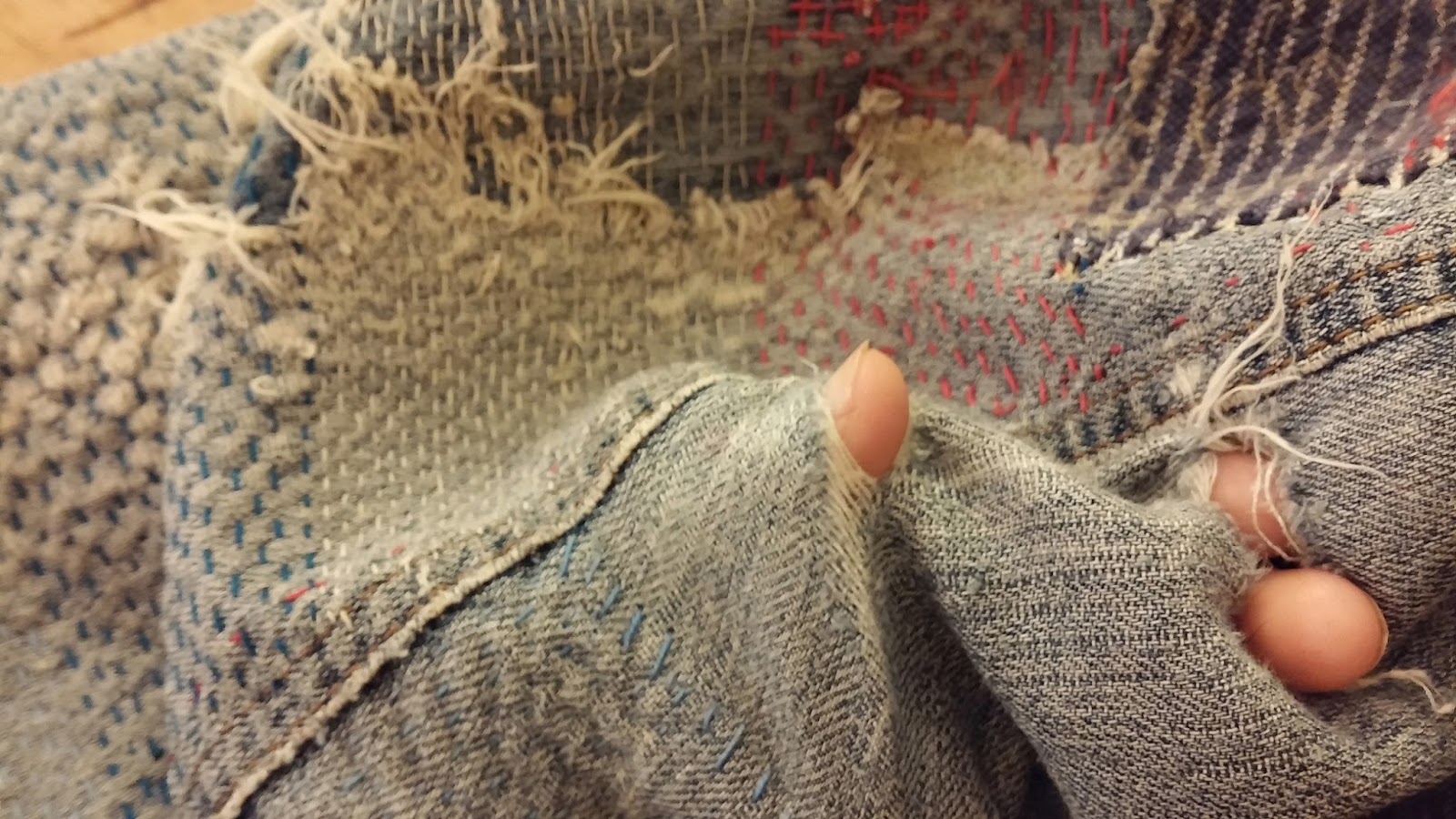
This is an artist that understands how important processes are. She became fascinated in the cycle of process that is so much a part of northern Japanese Boro textiles. She finds this particular approach to fabric, the rich layers of wear and mend, sympathetic with her own ideals. Kirsty feels that there is something both tragic and fragile connected to the Boro textiles, yet at the same time she identifies a strength that can be found within the continuation of the process. 


She became so inspired that she set herself the task of adopting the method herself, taking her worn out pair of jeans and seeing how long she could keep the process of wear and mend going. the practise has become much more than an exercise, it has become an emotional bond. Kirsty feels a real and definite connection with her jeans, they have become, through the process of wear and mend, a part of her being, a part of who she is, another layer of herself. 

From this point she has begun to explore the much larger issue of the contemporary world's relationship to the casual discarding of mountains of fabric. The idea has become endemic that we can easily discard anything and everything in our lives, that what we throw away is somehow taken out of existence, which of course is a cruel delusion. We live in a finite world, with finite space, and we are fast approaching the point where our discarded items are just being moved around the planet in ever larger mountains of the unwanted.


In this context she set herself the initial task of giving herself a framework to work in where she took on a one year shopping fast, integrating it into a make-do-and-mend challenge. Before the year was out, the framework became two years, and it is now a continuing process. Kirsty has followed the process so that it has become part of her lifestyle, she does not buy ready made clothes, she does not buy or accept gifts of garments or fabric. 

It has come to the point where the Japanese concept of mottainai 'too good to waste' has become a natural part of Kirsty's life, and she believes that it is something that will remain with her for the rest of her life. Her commitment to understanding her relationship to fabric, to mending, to the care of the physical environment of which we are all a part, should make us all stop and re-evaluate our own understanding and relationship with fabric. It is a path worth treading and if artists like Kirsty can lead the way, then we should be grateful to her and her example.


Check out Kirsty's online site Fibre Alchemy to follow her journey.